In today’s fast-paced world, delivering superior customer service requires more than trained staff—it requires smart systems that can manage customer flow, reduce congestion, and make service delivery faster and more organized. Whether it’s a hospital, bank, government office, or retail outlet, customers expect quick and streamlined service. This is where a queue management system becomes essential .
A queue management system (QMS) is a digital solution designed to organize incoming customers, assign them tokens, guide them through service counters, and reduce physical crowding. It enhances the overall customer experience, protects staff from unnecessary pressure, and provides real-time insights into service demand .
In the Kingdom of Saudi Arabia, where Vision 2030 is driving unprecedented digital transformation across every sector, queue management systems have become critical infrastructure for businesses and government institutions alike. From Riyadh to Jeddah to Dammam, organizations are adopting smart queuing solutions to modernize service delivery and meet the expectations of tech-savvy citizens and visitors .
This comprehensive guide explores everything you need to know about implementing a queue management system in Riyadh, the growing adoption of queue management systems in Saudi Arabia, and why choosing the right technology partner is essential for success.
Why Queue Management Systems Matter in Saudi Arabia
Saudi Arabia’s service sector is expanding rapidly, with banks, hospitals, government offices, and retail outlets handling increasing customer volumes daily. Traditional manual queue management methods—like standing in long lines or taking paper tickets—are no longer sufficient to meet modern customer expectations .
The Customer Experience Imperative
In cities like Riyadh, where residents and visitors have high expectations for service quality, poor queue management can damage business reputation. Consider these market realities:
- 70% of Saudis prefer organized service environments that respect their time
- Long waiting times lead to customer frustration and abandonment
- Disorganized queues create stress for both customers and staff
- Manual queue management is prone to errors and disputes
- Without data, businesses cannot optimize staffing or service delivery
A modern queue management system addresses all these challenges by digitizing the entire customer journey—from check-in to service completion .
Alignment with Vision 2030
The adoption of queue management systems aligns perfectly with Saudi Arabia’s Vision 2030 objectives. As the nation diversifies its economy and embraces digital transformation across all sectors, modern QMS solutions contribute directly to several key goals :
- Digital Transformation Leadership: Vision 2030 emphasizes technology in building a vibrant society and thriving economy. Advanced queue management represents the practical application of this vision, bringing digital efficiency to everyday customer interactions .
- Enhanced Quality of Life: Faster, more accurate, and more convenient service experiences contribute to improved quality of life for Saudi citizens and residents .
- Government Service Excellence: Public sector organizations implementing QMS demonstrate commitment to citizen satisfaction and transparent service delivery .
Key Benefits of Queue Management Systems
Reduced Wait Times: QMS helps minimize waiting times by efficiently organizing customers and optimizing service delivery. Customers don’t have to stand in long queues—they can sit comfortably until their token is called .
Enhanced Customer Experience: Organized and respectful service increases trust and satisfaction. Customers appreciate a well-organized queue system that reduces frustration and improves service speed .
Improved Staff Productivity: Staff can focus entirely on service instead of controlling crowds. By automating customer flow, businesses can serve more people in less time, boosting productivity .
Real-Time Data and Analytics: QMS provides valuable insights into customer flow, peak hours, and service performance. Dashboard insights help in scheduling staff according to high traffic hours .
Professional Environment: Digital displays and structured queues create a modern and premium feel that enhances brand perception .
Better Compliance and Safety: During health concerns, digital queue management reduces crowding and ensures appropriate distancing between customers .
Key Components of a Modern Queue Management System
An effective queue management system integrates multiple technologies to create a seamless customer experience. When evaluating solutions for the Saudi market, understanding these components is essential .
1. Self-Service Kiosks
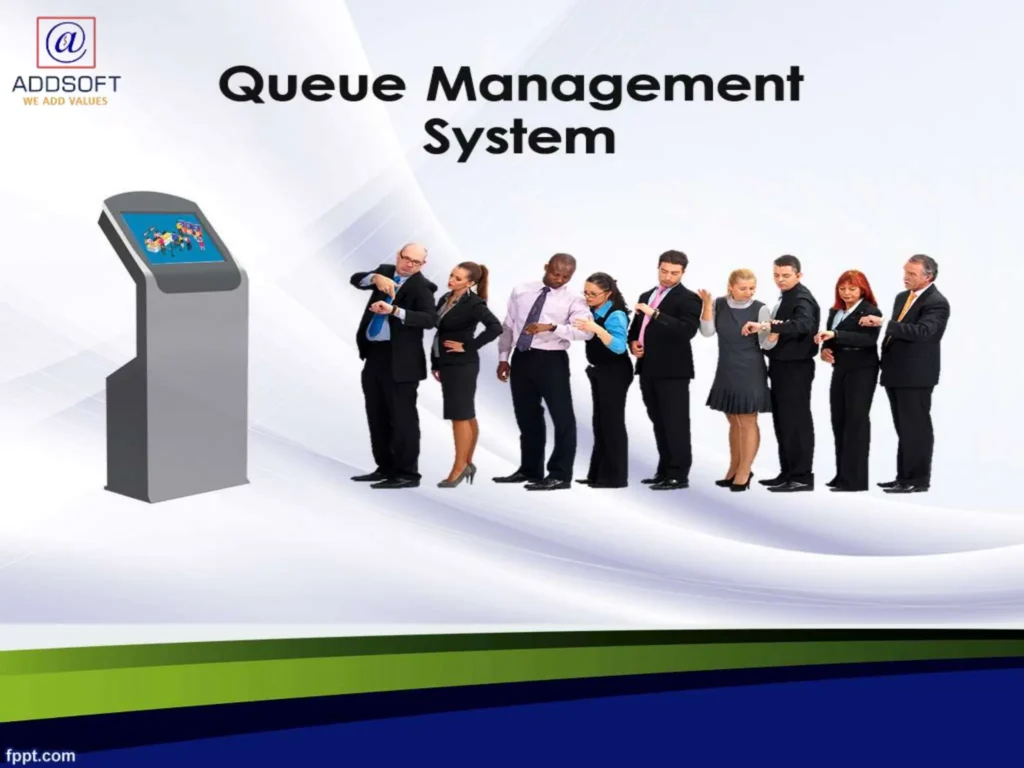
Self-service kiosks enable easy customer check-in for seamless service. Customers select their required service from a touchscreen interface and receive a queue ticket with their number and estimated wait time .
Modern kiosks feature:
- Intuitive touchscreen interfaces
- Multilingual support (English and Arabic)
- Durable construction for high-volume environments
- Integrated ticket printing
- Optional biometric or ID card integration
The Ministry of Commerce and Investment in Saudi Arabia successfully implemented kiosks with 50 service categories, each allocated to specific counters, serving up to 300 customers daily per location .
2. Digital Signage and Display Systems
Digital signage displays queue status, estimated wait times, and service updates in real time. These screens keep customers informed and reduce anxiety about when they will be served .
Key features include:
- High-brightness displays visible in all lighting conditions
- Integration with audio announcement systems
- Customizable layouts and branding
- Multi-zone support for different service areas
The Ministry of Commerce and Investment deployed 55-inch screens in waiting areas along with LCD Counter Display Units at every counter, creating a fully integrated visual system .
3. Mobile Notifications and Virtual Queuing
Modern QMS solutions alert customers via SMS or app-based updates when their turn is approaching. This allows customers to wait comfortably rather than standing in line .
Virtual queue options enable customers to:
- Join queues remotely before arriving
- Receive real-time position updates
- Get estimated wait times
- Arrive exactly when their turn is approaching
4. Counter Management Software
Staff interface with the system through intuitive counter management software that allows them to:
- Call the next customer
- Pause or redirect tickets
- Handle special cases or priority customers
- Track service times and performance
5. Customer Feedback Systems
Modern QMS solutions include feedback collection at service counters. The Ministry of Commerce and Investment installed Customer Feedback Units at every counter, allowing visitors to record their experience immediately after service .
This real-time feedback:
- Provides actionable insights for management
- Tracks satisfaction trends over time
- Identifies areas needing improvement
- Demonstrates commitment to service quality
6. Real-Time Analytics Dashboard
Management gains insights into wait times, service efficiency, and customer trends through comprehensive analytics. This data drives continuous improvement and resource optimization .
The Spectra reporting tool, used by the Ministry of Commerce and Investment, provides:
- Live dashboards showing daily tickets served
- Average waiting time metrics
- Real-time queue length monitoring
- Satisfaction measurements from feedback tablets
- Data-driven decision-making capabilities
7. Multi-Location Support
For businesses with multiple branches, enterprise QMS solutions provide centralized management and reporting across all locations .
Queue Management System in Riyadh
Riyadh, the capital and largest city of Saudi Arabia, is home to numerous government institutions, banks, hospitals, and corporate offices that handle thousands of visitors daily. The demand for a queue management system in Riyadh has grown significantly as organizations seek to modernize their service delivery .
Key Sectors Adopting QMS in Riyadh
Government Offices: Riyadh hosts federal government departments, Ministry of Commerce and Investment offices, passport services, and civic centers that serve citizens from across the Kingdom. These institutions increasingly rely on QMS to manage high volumes and reduce waiting times .
The Ministry of Commerce and Investment’s implementation of Wavetec’s Queue Management System across 20 locations represents a landmark achievement in government service modernization. This deployment features:
- Sleek ticket dispensing units at entrances
- 55-inch waiting area screens
- LCD Counter Display Units at every counter
- Multilingual kiosks (Arabic and English)
- Customer feedback tablets at each counter
- Spectra portal for management analytics
Results of this implementation include:
- Organized queues replacing chaotic waiting areas
- Reduced waiting times for citizens
- Minimized congestion at service centers
- Live statistics enabling better decision-making
- Educational content via digital signage about processes
Healthcare Facilities: Riyadh’s leading hospitals use QMS to manage patient appointments, emergency cases, and outpatient departments efficiently. Digital queue management ensures that patients receive timely care and reduces congestion in waiting areas .
Banks and Financial Institutions: Banks throughout Riyadh use QMS to reduce long waiting lines and provide seamless services to customers. Digital ticketing ensures fair service order and helps banks manage peak hour traffic .
Corporate Headquarters: With Riyadh serving as the business hub of the Kingdom, corporate offices implement QMS for HR departments, employee services, and visitor management.
Diplomatic Missions and Visa Centers: As the diplomatic capital, Riyadh houses numerous embassies and consulates where visa application centers handle high volumes of applicants daily. QMS helps organize applicant flow and improve processing efficiency.
Educational Institutions: Universities and colleges in Riyadh implement QMS for student admissions, fee payments, and administrative tasks, streamlining operations during peak enrollment periods.
Why Riyadh Businesses Prefer Digital Queue Management
- High Customer Traffic: Institutions handle thousands of daily visitors requiring organized service
- Government Digital Transformation: Public sector modernization initiatives drive QMS adoption
- Professional Image: International visitors and businesses expect world-class service standards
- Data-Driven Management: Real-time insights enable better resource allocation
- Vision 2030 Alignment: Contributing to national digital transformation goals
Queue Management System in Saudi Arabia
Across Saudi Arabia, from Jeddah to Dammam to Makkah, organizations are recognizing the transformative power of queue management systems. The adoption of queue management systems in Saudi Arabia spans multiple sectors and continues to accelerate .
Market Growth and Trends
The Saudi Arabia Queue Management System market is gaining prominence, especially in sectors like healthcare, government, and retail. The market is witnessing substantial growth as businesses and organizations focus on providing efficient and organized customer service and queuing experiences .
Key Market Drivers:
- Increasing Demand for Operational Efficiency: Organizations implementing automation can significantly streamline processes and enhance productivity .
- Rise in Cloud-Based Solutions: The cloud computing market in Saudi Arabia reflects a significant shift towards cloud-based solutions, enabling businesses to adopt QMS without heavy upfront infrastructure investments .
- Government Digital Transformation Initiatives: The Saudi government has allocated substantial funding for digital transformation, creating a favorable environment for QMS adoption .
- COVID-19 Impact: The pandemic emphasized the importance of efficient queue management for maintaining social distancing and ensuring customer safety in healthcare, retail, and government offices .
National Adoption Across Major Cities
Jeddah: As Saudi Arabia’s commercial hub and gateway to Makkah, Jeddah sees high customer volumes across sectors:
- Healthcare facilities manage patient flow efficiently
- Banks reduce branch congestion
- Retail centers enhance customer experience
- Government offices streamline citizen services
Dammam and Eastern Province: The industrial heart of Saudi Arabia adopts QMS for:
- Corporate services in energy and petrochemical companies
- Banking centers serving employees and residents
- Healthcare facilities for growing communities
- Government service centers supporting the region
Makkah and Madina: The holy cities implement QMS for:
- Hotel check-ins during Umrah and Hajj seasons
- Banking services for pilgrims and residents
- Government offices serving visitors
- Healthcare facilities managing patient flow
Industries Transforming with QMS in Saudi Arabia
Government and Public Sector: Public sector organizations are leading QMS adoption to enhance citizen satisfaction, improve transparency, and track service delivery metrics. The Ministry of Commerce and Investment’s successful implementation demonstrates the transformative potential of QMS in government services .
Key applications include:
- Business registration and licensing
- Commercial dispute resolution
- Document attestation services
- Investor facilitation centers
Healthcare: Hospitals and clinics across Saudi Arabia use QMS to:
- Manage outpatient departments
- Coordinate between departments
- Reduce patient wait times
- Improve treatment workflow
- Maintain social distancing
Banking and Financial Services: Saudi banks handle millions of customer transactions daily. QMS helps them:
- Reduce branch congestion
- Improve service quality
- Track teller performance
- Manage priority customers efficiently
- Enhance the overall banking experience
Retail and Consumer Goods: Shopping centers and retailers adopt QMS to:
- Manage checkout queues
- Handle customer service desks
- Coordinate product returns and exchanges
- Improve store operations during peak seasons
Telecommunications: Customer service centers use QMS to:
- Handle sales and support inquiries
- Manage peak hour traffic
- Improve agent utilization
- Enhance customer experience
Travel and Hospitality: With Saudi Arabia’s growing tourism sector, QMS helps:
- Manage hotel check-ins and check-outs
- Coordinate tour group services
- Handle airport services and transfers
- Improve guest experiences
The Technology Behind Modern Queue Management
Understanding the technology stack helps businesses make informed decisions when selecting a queue management system.
Cloud-Based vs. On-Premise Solutions
Cloud-Based QMS:
- Lower upfront investment
- Automatic updates and maintenance
- Remote management capabilities
- Scalable for growing businesses
- Accessible from anywhere
- Growing rapidly in Saudi Arabia
On-Premise QMS:
- Complete data control
- No ongoing subscription costs
- Customizable to specific needs
- Independent of internet connectivity
- Suitable for sensitive installations
Integration Capabilities
Modern QMS solutions integrate seamlessly with:
- Existing IT Infrastructure: ERP systems, CRM platforms, and databases
- Communication Channels: SMS gateways, mobile apps, and email systems
- Hardware Components: Ticket printers, display screens, and audio systems
- Analytics Tools: Business intelligence and reporting platforms
Artificial Intelligence in Queue Management
AI is transforming queue management with capabilities including:
- Predictive Analytics: Forecasting peak hours and customer volumes
- Intelligent Routing: Matching customers with the most appropriate service agents
- Anomaly Detection: Identifying unusual patterns or potential issues
- Natural Language Processing: Enabling voice-based check-in and inquiries
The AI market in Saudi Arabia is anticipated to grow significantly, indicating robust interest in integrating advanced technologies into business operations .
Real-Time Monitoring and Reporting
Advanced QMS platforms provide comprehensive monitoring capabilities:
- Live dashboards showing queue status
- Historical data for trend analysis
- Performance metrics by counter and agent
- Customer satisfaction tracking
The Spectra platform implemented by the Ministry of Commerce and Investment demonstrates how real-time data enables management to make better, timely decisions in improving customer experience .
Top Company for Queue Management Systems in Saudi Arabia
Choosing the right technology partner is crucial for successful QMS implementation. The ideal partner must understand local market dynamics, provide solutions tailored to Saudi requirements, and offer comprehensive support across the Kingdom.
The NextGen Technologies stands as a premier provider of cutting-edge queue management solutions in Saudi Arabia. As a top company in the field, they bridge the gap between international technology standards and local market requirements, delivering comprehensive systems that drive operational excellence and customer satisfaction.
Why The NextGen Technologies Leads the Market
Fully Customizable QMS Solutions: Every business has unique needs. The NextGen Technologies designs custom solutions for every environment, ensuring that the system fits specific operational requirements rather than forcing businesses to adapt to rigid software.
Modern and Attractive Token Kiosks: Stylish interfaces and smooth performance enhance the customer experience from the moment they check in. Touch-screen token machines feature intuitive designs that customers can use without assistance.
Digital Display and Voice Announcement Systems: Counters and service areas stay professional and organized with integrated display and announcement systems. Customers never miss their turn, and staff can focus entirely on service.
Real-Time Reporting Dashboard: Managers can monitor customer flow, service time, and staff efficiency through comprehensive analytics. Real-time data enables proactive management and continuous improvement.
Mobile and Virtual Queue Solutions: Customers can join queues using their phones, reducing physical wait times and enabling social distancing. This modern approach appeals to tech-savvy Saudi consumers.
Multilingual Support: With full support for Arabic and English interfaces, The NextGen Technologies ensures that systems serve the diverse population of Saudi Arabia effectively .
Long-Term Support and Maintenance: The company provides complete installation, training, and ongoing maintenance services. Their team ensures that systems operate reliably year after year.
Affordable Pricing: High-quality QMS at competitive market rates makes advanced queue management accessible to businesses of all sizes.
Types of Queue Management Solutions Offered
The NextGen Technologies provides a comprehensive range of solutions:
- Single Counter Queue System
- Multi-Counter Token System
- Hospital Queue Management
- Bank Queue Flow System
- Customer Service Queue System
- Government Office Queue Management
- Reception and Appointment-Based Queue System
- Mobile and Cloud Queue System
- Voice-Integrated Queue System
- Touch-Screen Token Machines
Proven Results Across Saudi Arabia
The NextGen Technologies has successfully deployed QMS solutions across the Kingdom, delivering measurable outcomes:
- Reduced customer wait times by 40-60%
- Improved staff productivity through automated workflows
- Enhanced customer satisfaction scores
- Real-time visibility into operations for management
- Professional service environments that build customer trust
For businesses seeking to transform their customer service operations, The NextGen Technologies is the trusted partner that delivers innovation, reliability, and measurable results. Visit their website at thenextgentechnologies.com to explore their comprehensive range of queue management solutions.
How to Implement an Effective Queue Management System
To ensure successful QMS implementation, businesses should follow a structured approach .
Step 1: Assess Business Needs
Determine the specific requirements of your business and select a queue management system that aligns with your customer flow. Consider:
- Average daily customer volume
- Peak hours and seasonal variations
- Number of service counters
- Types of services offered
- Existing infrastructure and systems
Step 2: Choose the Right Technology
Opt for digital solutions such as self-service kiosks, mobile queue apps, and AI-powered queue management that match your requirements and budget .
Step 3: Plan Physical Layout
Design your waiting area to accommodate the QMS:
- Position kiosks for easy access at entrances
- Place display screens where all customers can see them
- Ensure clear pathways to service counters
- Create comfortable waiting areas with adequate seating
Step 4: Train Staff Efficiently
Provide proper training to employees to handle the QMS effectively and ensure smooth operations. Staff should understand:
- How to use counter management software
- Procedures for handling exceptions
- Troubleshooting common issues
- Customer communication during busy periods
Step 5: Test Before Launch
Conduct thorough testing before going live:
- Verify all hardware components function correctly
- Test integration with existing systems
- Simulate peak traffic scenarios
- Gather feedback from staff during testing
Step 6: Use Data Analytics
Leverage real-time data insights to optimize service efficiency and make informed business decisions. Monitor:
- Average wait times by time of day
- Service times by counter or staff member
- Customer volumes and patterns
- Peak period performance
Step 7: Ensure Customer Engagement
Keep customers informed with real-time queue status updates via SMS, mobile apps, or display screens. Clear communication reduces anxiety and improves satisfaction .
Step 8: Collect and Act on Feedback
Implement customer feedback systems at service counters and use the data for continuous improvement. The Ministry of Commerce and Investment’s success demonstrates the value of real-time feedback collection .
Future of Queue Management Systems in Saudi Arabia
The demand for digital queue management solutions in Saudi Arabia is expected to grow rapidly in the coming years. Key future trends include :
AI-Powered Queue Management
Artificial intelligence will enhance customer flow predictions and automate queue handling. AI algorithms will:
- Predict peak times with greater accuracy
- Recommend optimal staffing levels
- Identify bottlenecks before they cause delays
- Personalize customer interactions
Mobile App Integration
Businesses will integrate QMS with mobile apps, allowing customers to:
- Join virtual queues remotely
- Receive real-time updates on wait times
- Book appointments seamlessly
- Provide feedback after service
Contactless and Self-Service Solutions
Self-check-in kiosks and contactless systems will further optimize queue management, reducing physical contact and improving hygiene .
Cloud-Based Queue Systems
Cloud-based solutions will enable businesses to:
- Manage queues remotely across multiple locations
- Access real-time data from anywhere
- Scale easily during growth periods
- Reduce IT infrastructure costs
Biometric and Facial Recognition Technology
Future queue systems may incorporate biometric authentication for:
- Faster customer identification
- Secure verification processes
- Personalized service based on customer history
- Reduced check-in time
Integration with Smart City Initiatives
As Saudi Arabia develops smart city projects like NEOM, queue management systems will integrate with broader urban technology infrastructure, contributing to:
- Improved public services
- Enhanced citizen experience
- Data-driven urban planning
- Efficient resource utilization
Expanded Applications
Beyond traditional sectors, QMS concepts will expand to new industries including:
- Transportation and logistics hubs
- Energy and utility customer service centers
- Entertainment and event venues
- Sports facilities during major events
Return on Investment: The Business Case for QMS
Investing in a queue management system delivers measurable financial returns for Saudi businesses.
Direct Cost Savings
- Reduced Staffing Requirements: Automated queue management allows optimized staff deployment
- Lower Training Costs: Standardized processes reduce training time for new employees
- Minimized Errors: Digital ticketing eliminates manual entry mistakes
- Extended Equipment Life: Proper customer flow reduces wear on facilities
Revenue Enhancement
- Increased Customer Throughput: Serve more customers in the same time period
- Higher Customer Retention: Satisfied customers return more frequently
- Improved Upselling: Digital displays enable targeted promotions
- Reduced Abandonment: Fewer customers leave due to long waits
Intangible Benefits
- Brand Reputation: Professional service enhances brand image
- Employee Morale: Reduced stress improves staff satisfaction
- Regulatory Compliance: Meet government service standards
- Competitive Advantage: Stand out from competitors with manual systems
- Vision 2030 Contribution: Support national digital transformation goals
Conclusion
Queue management systems have revolutionized the way businesses operate in Saudi Arabia, ensuring faster, more efficient service delivery across major cities including Riyadh, Jeddah, and Dammam. From banks and hospitals to government offices and retail outlets, QMS is transforming industries by reducing wait times, improving staff efficiency, and enhancing customer satisfaction .
In Riyadh, the capital city, government institutions and private businesses alike are adopting digital queue management to meet the expectations of citizens, residents, and international visitors. The Ministry of Commerce and Investment’s successful implementation across 20 locations demonstrates how QMS can transform public service delivery and contribute directly to Vision 2030 goals .
Across Saudi Arabia, organizations are recognizing that customer experience is the new competitive battleground. A queue management system is no longer a luxury—it’s a necessity for businesses committed to excellence in service delivery.
The key to success lies in choosing the right technology partner. The NextGen Technologies stands as Saudi Arabia’s premier provider of queue management solutions, offering customizable systems, modern hardware, real-time analytics, and comprehensive support. Their solutions help businesses create organized, professional service environments that build customer trust and loyalty.
As technology continues to evolve with AI, mobile integration, and cloud-based solutions, businesses must adapt to digital queue management to stay ahead of customer expectations and maintain a competitive edge. The future of customer service in Saudi Arabia is digital, organized, and efficient—and it’s powered by advanced queue management systems from innovative providers like The NextGen Technologies.
Visit thenextgentechnologies.com today to discover how the right queue management system can transform your customer service operations and position your business for success in Saudi Arabia’s rapidly evolving market.
Frequently Asked Questions (FAQs)
1. What is a queue management system and how does it work?
A queue management system (QMS) is a technology-driven solution designed to organize customer flow, reduce waiting times, and optimize service efficiency . It typically includes self-service kiosks where customers receive numbered tickets, digital displays showing current queue status, audio announcements calling customers to counters, and management software for staff . Customers check in, receive a token, and wait comfortably until their number is called, eliminating physical queues and creating a more organized service environment. Modern systems also include real-time analytics dashboards and customer feedback collection .
2. What industries in Saudi Arabia benefit most from queue management systems?
Industries with high customer volumes benefit tremendously from QMS. In Saudi Arabia, the government and public sector leads adoption, with ministries like the Ministry of Commerce and Investment implementing comprehensive solutions across multiple locations . Healthcare facilities use QMS to manage patient flow efficiently, banks and financial institutions reduce branch congestion, retail outlets enhance customer experience, telecommunications companies handle customer inquiries effectively, and educational institutions streamline admissions and administrative processes . Any organization where customers wait for service can benefit from queue management.
3. Why is The NextGen Technologies considered a top provider of queue management systems in Saudi Arabia?
The NextGen Technologies stands out due to its comprehensive, customized approach to queue management. They offer fully customizable solutions tailored to each client’s unique needs, modern and attractive token kiosks, integrated digital display and voice announcement systems, real-time reporting dashboards, mobile and virtual queue options, multilingual support (Arabic and English), and long-term support and maintenance. Their affordable pricing and proven track record across multiple industries make them a trusted partner for businesses throughout the Kingdom.
4. How does a queue management system improve customer experience in Saudi organizations?
A QMS improves customer experience in multiple ways: it eliminates physical queues so customers can wait comfortably, reduces waiting times through efficient service organization, provides transparency with estimated wait times and queue positions, creates a professional environment with digital displays and organized flow, and reduces anxiety by keeping customers informed . When customers feel respected and served efficiently, satisfaction increases significantly. The Ministry of Commerce and Investment’s implementation demonstrated how QMS reduces chaos and creates organized, professional service environments .
5. Can queue management systems integrate with existing business software in Saudi Arabia?
Yes, modern queue management systems are designed for seamless integration with existing business infrastructure. They can connect with CRM systems to access customer data, ERP platforms for comprehensive reporting, SMS gateways for mobile notifications, and existing hardware like displays and printers . Advanced platforms like the Spectra reporting tool provide live dashboards showing all important information collected through the QMS, enabling data-driven decision-making . The NextGen Technologies provides solutions that integrate smoothly with your current systems, ensuring a unified technology ecosystem without requiring complete infrastructure overhauls.