
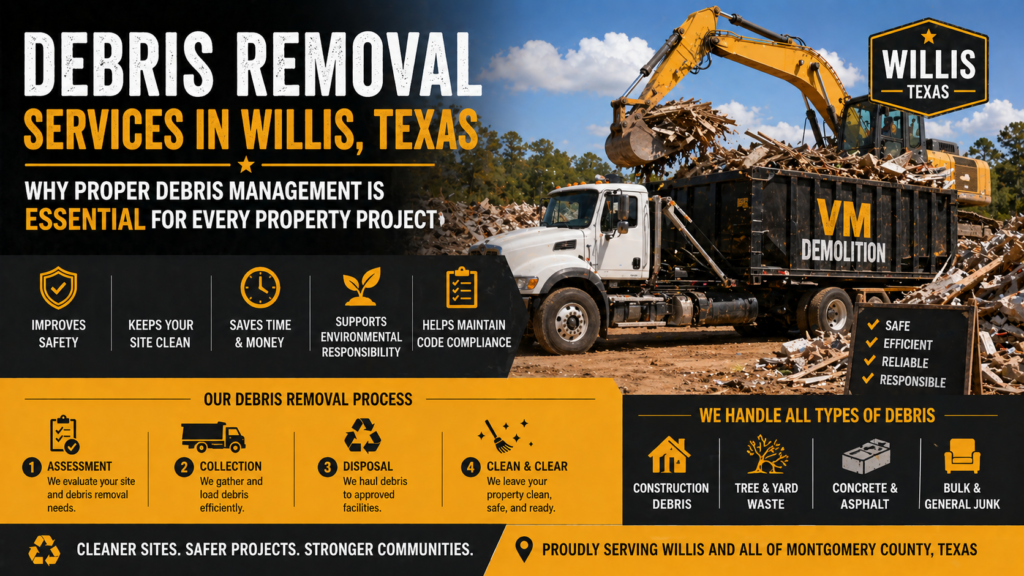
After any significant property project a demolition, a land clearing operation, a renovation, a storm cleanup, or even a seasonal property cleanout the resulting debris presents a challenge that does not resolve itself. Piles of broken concrete, splintered wood, torn roofing material, cleared brush, contaminated soil, and assorted waste materials must be collected, transported, and disposed of appropriately. The debris removal process is not simply an afterthought to the more dramatic work that precedes it. It is a critical component of any complete property project, and how it is handled has real consequences for the property, for public infrastructure, and for the environment.
In Willis, Texas and across Montgomery County, the demand for professional Debris Removal Service Willis has grown alongside the area’s remarkable development activity. Understanding what debris removal involves, what types of material it encompasses, and why professional management of this process matters helps property owners plan their projects completely from start to finish rather than discovering late in the process that the debris problem is larger than anticipated.
What Debris Removal Actually Covers
The term debris removal encompasses a broader range of material types and situations than is often initially apparent. The specific category of debris has significant implications for how it must be handled, transported, and disposed of.
Construction and demolition debris is the largest category by volume in a growing market like Willis. Demolished buildings produce enormous quantities of concrete, masonry, structural lumber, drywall, roofing materials, metal framing, plumbing fixtures, electrical components, and mixed building materials. This material varies widely in its recyclability and its appropriate disposal pathway. Concrete and clean masonry can typically be recycled as aggregate fill. Clean dimensional lumber may be usable for other applications. Metal is highly recyclable. Gypsum wallboard has specific disposal considerations. Mixed demolition debris often requires sorting to separate recyclable materials from waste that must go to landfill.
Land clearing debris consists of the organic material generated by removing trees, brush, and undergrowth from a property. This includes logs, limbs, stumps, and root systems as well as finer material from understory vegetation. Organic debris from clearing operations is often managed on-site through chipping and mulching, but where site conditions do not allow mulching or where the volume of material exceeds what can be beneficially managed on the property, hauling to an appropriate processing or composting facility is required.
Storm debris results from weather events the severe thunderstorms, tropical depressions, and occasional hurricane remnants that affect the Gulf Coast region of Texas. Storm debris includes fallen trees and branches, damaged roofing and siding materials, flooded furnishings and contents, and various combinations of wind and water-damaged materials. The Gulf Coast climate that defines the weather pattern for Willis means that storm debris removal is a recurring necessity for many property owners in the area.
Renovation and remodel debris is generated by interior and exterior renovation projects. Removing old flooring, gutting kitchens and bathrooms, replacing roofing systems, and demolishing out-of-date additions all produce debris that must be removed from the property. Unlike full demolition projects where a single contractor handles both the demolition and the debris removal, renovation projects may generate debris over an extended period that requires periodic removal.
Illegal dump and property cleanout debris is a practical reality in some parts of the Willis area, where undeveloped and rural properties can attract unauthorized dumping of waste materials. Clearing accumulated dump debris from a property which may include appliances, tires, household waste, and various discarded materials requires sorting, appropriate disposal routing for different material types, and in some cases coordination with local environmental authorities where regulated waste is discovered.
The Debris Removal Process
Professional debris removal is not simply loading material into a truck and driving away. The process involves a systematic approach to collecting, sorting, handling, and disposing of material in a manner that is efficient, responsible, and compliant with applicable regulations.
Assessment is the first step. A professional debris removal contractor evaluates the type, volume, and composition of the material on site, identifying any materials that require special handling asbestos-containing materials, lead paint, household chemicals, regulated waste and developing a removal plan that addresses the full scope of what needs to be removed.
Sorting and segregation during the removal process separates recyclable materials from waste, hazardous materials from non-hazardous, and different material types from each other. This segregation serves multiple purposes: it allows recyclable materials to be diverted from landfill, it ensures that hazardous materials are routed to appropriate disposal facilities, and it can reduce the overall cost and environmental impact of the removal by minimizing the volume of material sent to general waste disposal.
Loading and transport requires appropriate equipment scaled to the job. Small residential cleanouts may be served by a single dump trailer, while large demolition or clearing projects may require multiple trucks making repeated trips to haul away significant volumes of material. In the Willis area, where road conditions and traffic patterns vary between developed urban areas and rural properties accessed by county roads, the logistics of debris hauling require local knowledge and appropriate vehicle selection.
Disposal routing ensures that material reaches the appropriate destination. Construction and demolition debris goes to permitted C&D landfills or recycling facilities. Clean wood debris may go to chipping or composting operations. Metal goes to scrap recycling. Hazardous materials require transport to licensed hazardous waste disposal facilities. Organic material may go to composting or mulching operations. The routing decisions made during debris removal have real consequences for environmental responsibility and for compliance with Texas waste disposal regulations.
Debris Removal and Environmental Responsibility in Southeast Texas
The Gulf Coast ecosystem of which Willis is a part is ecologically rich and environmentally sensitive. The watersheds that flow through Montgomery County eventually feed into the San Jacinto River and Galveston Bay systems, which support critical fisheries and coastal ecosystems. How debris from Willis-area properties is managed has downstream consequences for these systems.
Improper debris disposal illegal dumping, uncontrolled burning of materials that should not be burned, or routing materials to landfills that are not permitted for the material types being disposed of contributes to pollution of soil, water, and air in ways that degrade the local environment and create regulatory liability for property owners. Texas law imposes real penalties for illegal disposal of construction and demolition debris, and property owners who discover illegal dumps on their land can face cleanup obligations regardless of who created the dump.
Professional debris removal contractors understand these obligations and ensure that material is handled in compliance with applicable state and local regulations. For VM Demolition clients in Willis and across Montgomery County, debris removal is integrated with demolition, clearing, and excavating services to provide a complete, legally compliant, and environmentally responsible outcome.
Why Debris Removal Should Be Part of Project Planning from the Start
A common mistake property owners make is treating debris removal as a separate issue to be figured out after the primary work is done. This approach leads to delays, unexpected costs, and in some cases project complications when debris accumulates on site faster than it can be removed.
Planning debris removal as an integrated part of a demolition, clearing, or renovation project from the beginning allows the contractor to sequence the work efficiently, stage debris in ways that do not impede ongoing project activities, and ensure that disposal logistics are in place before they are urgently needed. It also allows the property owner to understand the full scope and timeline of the project rather than discovering late in the process that significant additional work and logistics are involved in getting the debris off site.
In the Willis and Montgomery County market, where development activity is intense and contractor schedules are often tight, having debris removal logistics planned and confirmed at the project outset is a practical necessity for keeping projects on schedule.